Professor Jasper F. Kok (CV) – Ph.D. (Applied Physics, University of Michigan, 2009)
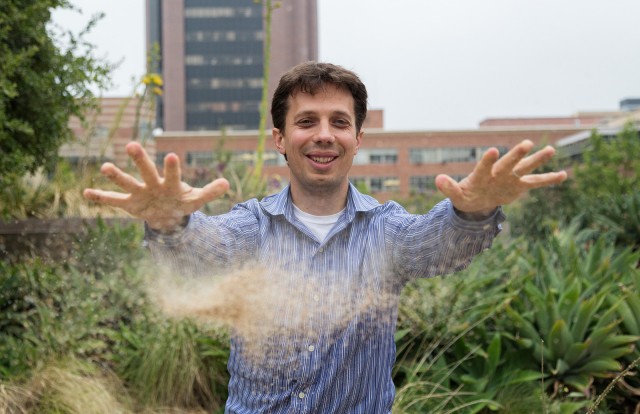
Jasper Kok was born in the Netherlands, where he obtained a B.S. in physics at Leiden University. He then moved to the United States for graduate school, and obtained his PhD in Applied Physics from the University of Michigan in 2009, for which he received a Distinguished Dissertation Award. He then took an Advanced Study Program postdoctoral fellowship at the National Center for Atmospheric Research, followed by an NSF Climate and Large-Scale Dynamics postdoctoral fellowship at Cornell University. Jasper joined the faculty at the department of Atmospheric and Oceanic Sciences at UCLA in 2013, was awarded an NSF CAREER grant in 2016, received tenure in 2017, received the American Meteorological Society’s Henry Houghton Early Career award in 2020, and was promoted to Full Professor in 2021.
Contact info:
Office: 7142 Math Sciences Building, UCLA
Email: jfkok@ucla.edu
Phone: Email is the best way to get a hold of me.
If you are a prospective student or postdoc and are interested in joining my group, feel free to contact me.

Postdoctoral scholar Xia Li (xiali007@atmos.ucla.edu) – Ph.D. (University of Utah)
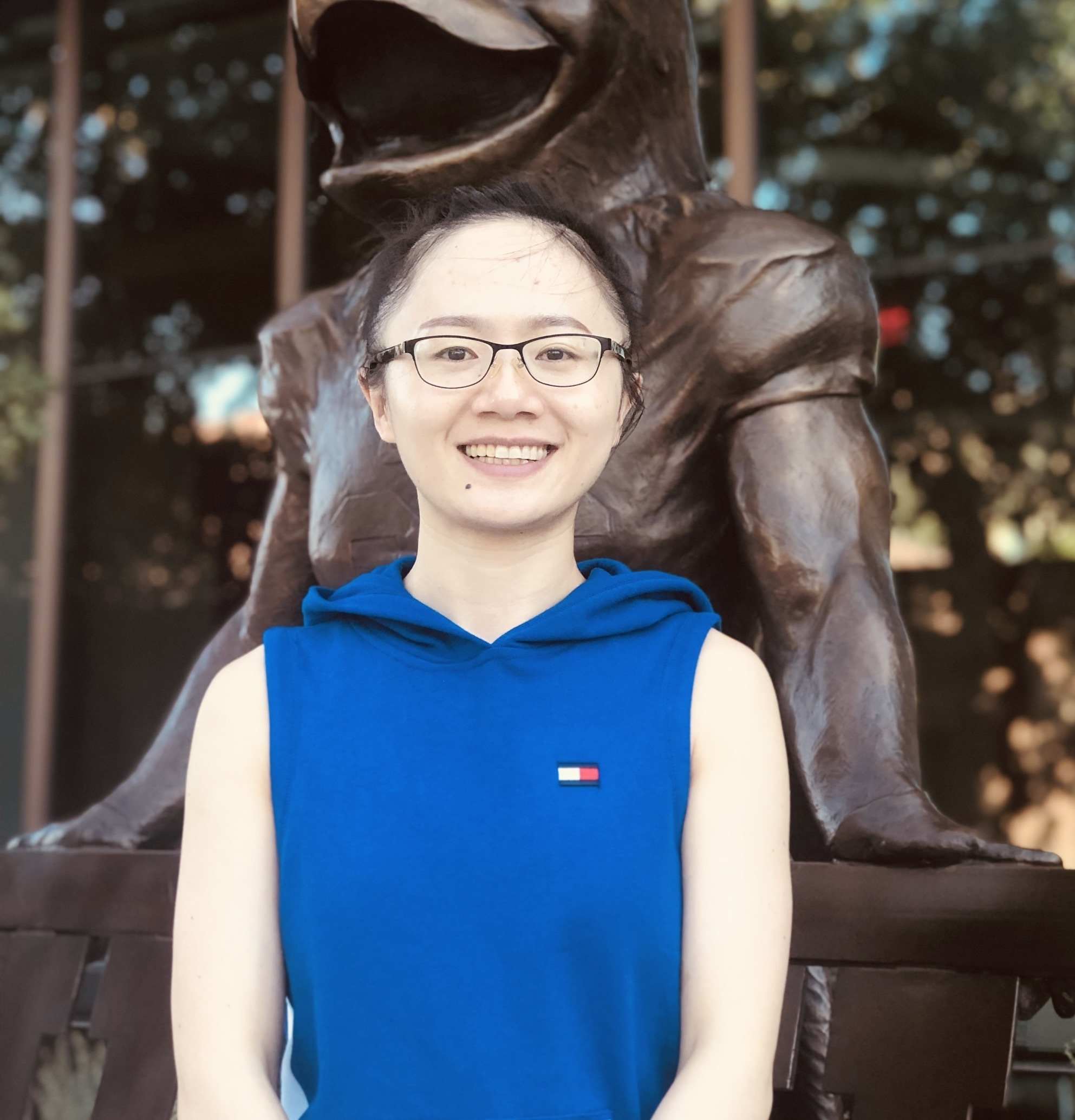
Xia Li is a postdoctoral researcher and joined the group in November 2024, following a postdoctoral fellowship in the Program in Atmospheric and Oceanic Sciences at Princeton University and a Ph.D. in Atmospheric Sciences from the University of Utah. Her research seeks innovative “polar solutions” to the global climate challenge, bridging subgrid-scale processes and planetary-scale implications. Specifically, she investigates subgrid-scale sea ice-cloud and cloud-radiation interactions, as well as large-scale climate intervention strategies, with a particular focus on cloud-based geoengineering in the polar regions. Her approach integrates observations with a hierarchy of modeling frameworks, ranging from large-eddy simulations to global climate models. Beyond research, she is passionate about public science outreach and dedicated to mentoring both undergraduate and graduate students.
Graduate student Vanessa Maciel (fvmaciel@ucla.edu) – B.S. (UC Santa Cruz), M.S. (San Jose State University)
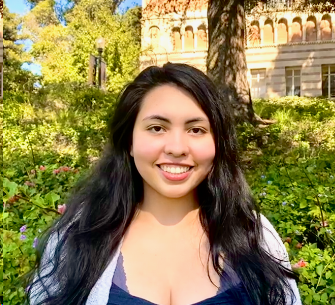
The presence of an ice nucleating particle (INP) can alter the ice crystal size distribution of a cirrus or mixed-phase cloud which controls how it interacts with incoming and outgoing radiation. Vanessa is currently using observational data to investigate the impacts that dust, an efficient INP, has on the microphysical structure of these clouds. It is important to fully understand this, especially in the context of climate change, as it is a major contribution to the uncertainty in global climate models. Therefore, she aims to build a climatology for dust in the cirrus and mixed-phase cloud regime for use in a model to help improve it. Vanessa is also serving as the Social Media Chair for Chi Epsilon Pi (XEP), the AOS department’s graduate student organization. In the future, she hopes to continue in academia in a faculty position where she can work on similar research and advise students from diverse backgrounds while creating an inclusive environment. In her free time, Vanessa enjoys drawing, afternoon tea, watching horror movies and cuddling with her cat.
Post-baccalaureate research assistant Katie Chan (chanks7550@g.ucla.edu) – B.S. (UCLA, 2025)
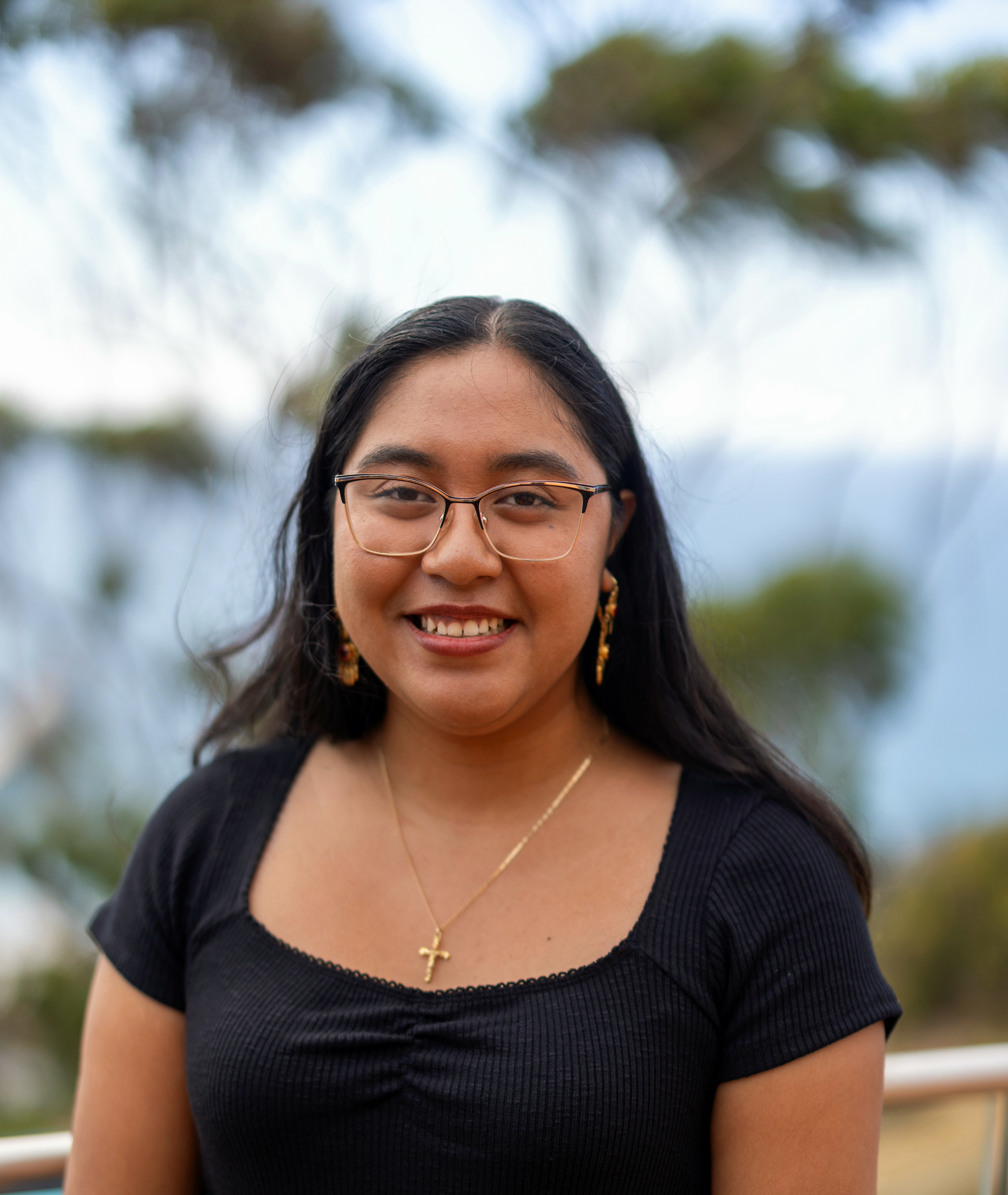
Katie is interested in understanding how ice-nucleating particles (INPs) influence mixed-phase cloud lifetime, precipitation processes, and net radiative effect. During her undergraduate research, she assessed aerosol-aware and dust-based INP parameterizations by applying size-resolved dust concentrations from our group’s global dust reanalysis product, DustCOMM, and comparing predictions with laboratory-derived INP measurements from the MOSAiC expedition in the central Arctic Ocean. As a Post-Baccalaureate Research Assistant, she is now studying the impacts of volcanic ash INPs on Arctic clouds using satellite observations to better understand the potential effects of seeding polar clouds as a geoengineering approach. During her undergraduate years at UCLA, she was actively involved in the AOS community as President of Undergraduate Chi Epsilon Pi (XEP) and became a Learning Assistant for multiple AOS courses. In the future, she hopes to pursue graduate studies in atmospheric science with a focus on heterogeneous ice nucleation. Outside of research, Katie enjoys playing guitar, visiting botanical gardens, watching Studio Ghibli films with friends, and searching for the best strawberry matcha spots in Los Angeles.
Undergraduate research assistant Yi Liu (liuyi0314@g.ucla.edu)
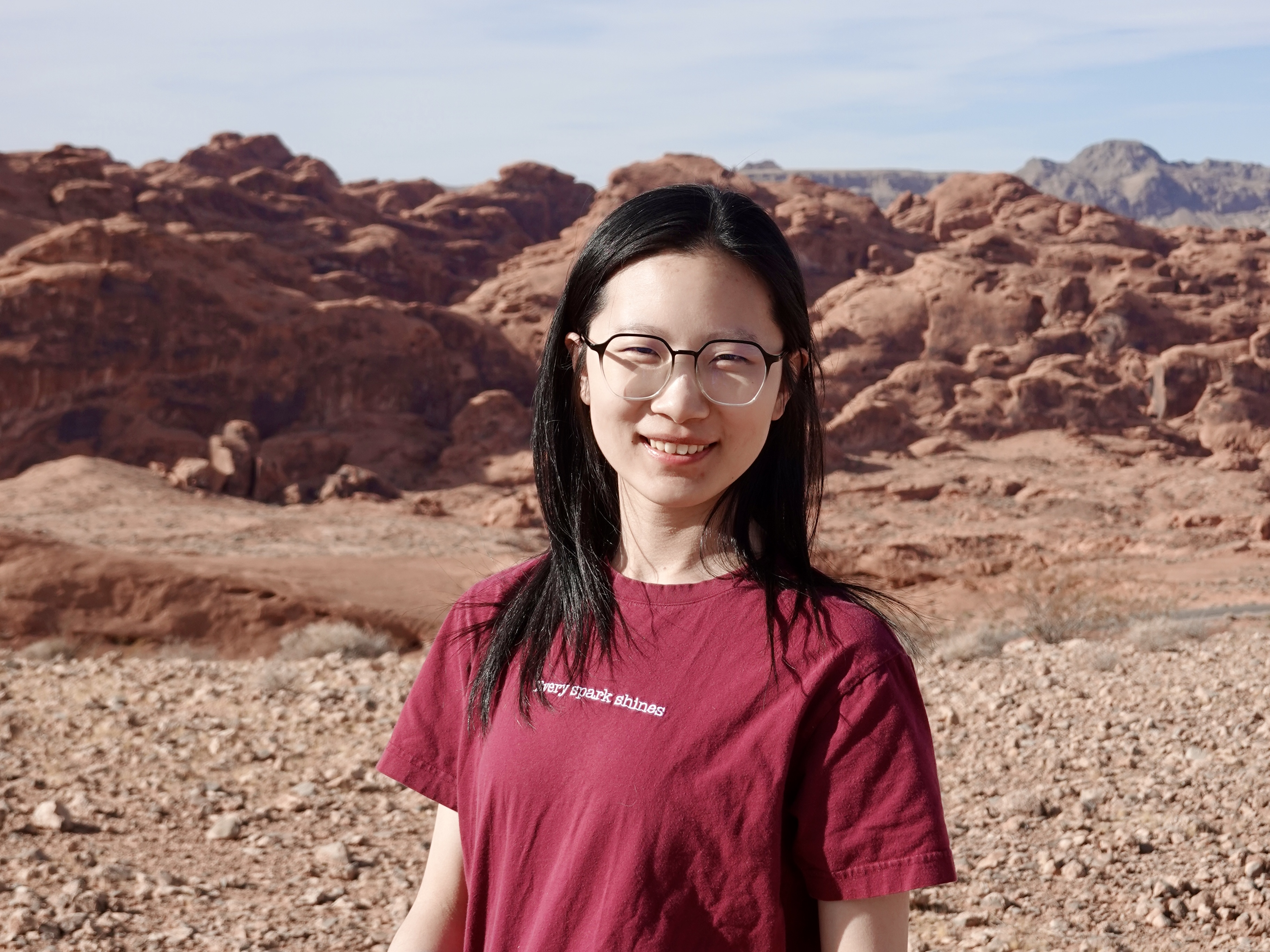
Yi is a fourth-year Applied Mathematics student at UCLA, with a minor in Atmospheric and Oceanic Science. Her research applies trend analysis to ground-based observations from AD-Net to investigate long-term changes in dust aerosol concentrations across East Asia. She is comparing her results with AERONET observations and CMIP6 model outputs to validate the identified trends and examine the limitations of each dataset.
Recent group alumni
Some happy research group members at 2019 graduation. From left-to-right: former undergraduate researchers Yang (Kitty) Wang, Kaylie Cohanim, Chloe Whicker, and Kenyon Chow.
Former project scientist Ashok Gupta (ashokgupta@atmos.ucla.edu)
Dr. Gupta’s research focused on reconstructing the variability of the global dust cycle over the 21st century. He also publishes a paper showing that the 2022 Hunga Tonga eruption did not warm but rather cooled the planet, as explained in this press release. Ashok is now a researcher at Vanderbilt University.
Former PhD student Danny Min Leung (dannymleung@ucla.edu) – PhD (UCLA, 2023)
For his PhD, Danny developed a detailed and more accurate parameterizations of the effects of boundary-layer turbulence, surface roughness, and other physical mechanisms on dust aerosol emissions. He incorporated this parameterization schemes into the default version of the Community Earth System Model (CESM), facilitated by an Advanced Study Program (ASP) graduate visitor fellowship. He is now an ASP postdoctoral fellow.
Former graduate student Yue Huang (hyue3@yahoo.com, website) – PhD (UCLA, 2021)
For her PhD, Yue worked on “Observational constraints on dust size and shape.” She did impactful work quantifying dust fluxes from sand dunes (here), quantifying the globally-representative asphericity of desert dust (here), and figuring out how to convert between different types of measurements of dust particle sizes so that comparisons between models and measurements are closer to comparing apples to apples (here). She is now a postdoctoral fellow with Ron Miller at Columbia University, for which she received a prestigious Earth Institute postdoctoral fellowship.
Former postdoctoral fellow Adeyemi Adebiyi (aaadebiyi@ucmerced.edu, website) – Ph.D. (University of Miami, 2016)
Yemi was a University of California President’s Postdoctoral Fellow whose work has shown that that the atmosphere contains an astonishing 17 million tons of coarse dust (particles with diameter > 5 um), which accounts about a third of the atmosphere’s total particulate matter load. Climate models account for only about a quarter of this coarse dust, thereby missing important effects on climate and weather. For this impactful work, Yemi received a prestigious Chancellor’s Award for Postdoctoral Research. Yemi is now an assistant professor at the University of California – Merced. Member of group from 2017 – 2021.
Less recent group alumni
Former MS student Olivia Salaben. Studied regional dust direct radiative effect and forcing over North Africa, using observational constraints on dust properties and abundance. Member of group from 2022-2024.
Former postdoctoral scholar Jun Meng (jun.meng@ucla.edu). Developed a new parameterization for the size distribution of emitted dust aerosols that accounts for super coarse dust. Now an assistant professor at Washington State University. Member of group from 2020 – 2022.
Former undergraduate researcher Robin Anthony-Petersen used satellite data to investigate impacts of dust on clouds in the tropical North Atlantic. Robin is currently a graduate student at the University of California – Berkeley. Member of group from 2019 – 2021.
Former undergraduate researcher Alana Dodero used satellite data during the 2020 massive “Godzilla” dust storm to investigate the impact of the asphericity of dust on its optical properties. Member of group in 2020. Now a graduate student at TAMU.
Former postdoctoral fellow Francesco Comola developed an insightful parameterization for climate models of the effects of turbulence on fluxes of sand and dust (here). Member of group from 2016 – 2019.
Former undergraduate researcher Chloe Whicker studied the surface concentration of desert dust, which has implications for understanding human health impacts. Chloe is currently a postdoctoral scholar at the University of California – Irvine, after graduating from the University of Michigan. Member of group from 2018 – 2019.
Former undergraduate researcher Kaylie Cohanim researched wind-blown sand transport on Earth and other planetary bodies (mainly Titan), and its implications on climate and the development of geological surfaces. Now a graduate student at UCLA. Member of group in 2018.
Former postdoctoral fellow Raleigh Martin performed extensive field measurements of wind-blown sand using novel methodology, resulting in a number of excellent publications. Member of group from 2013 – 2017. Now a Program Director in the Division of Earth Sciences at the National Science Foundation.
 The Aerosol-Climate Interactions Group - UCLA